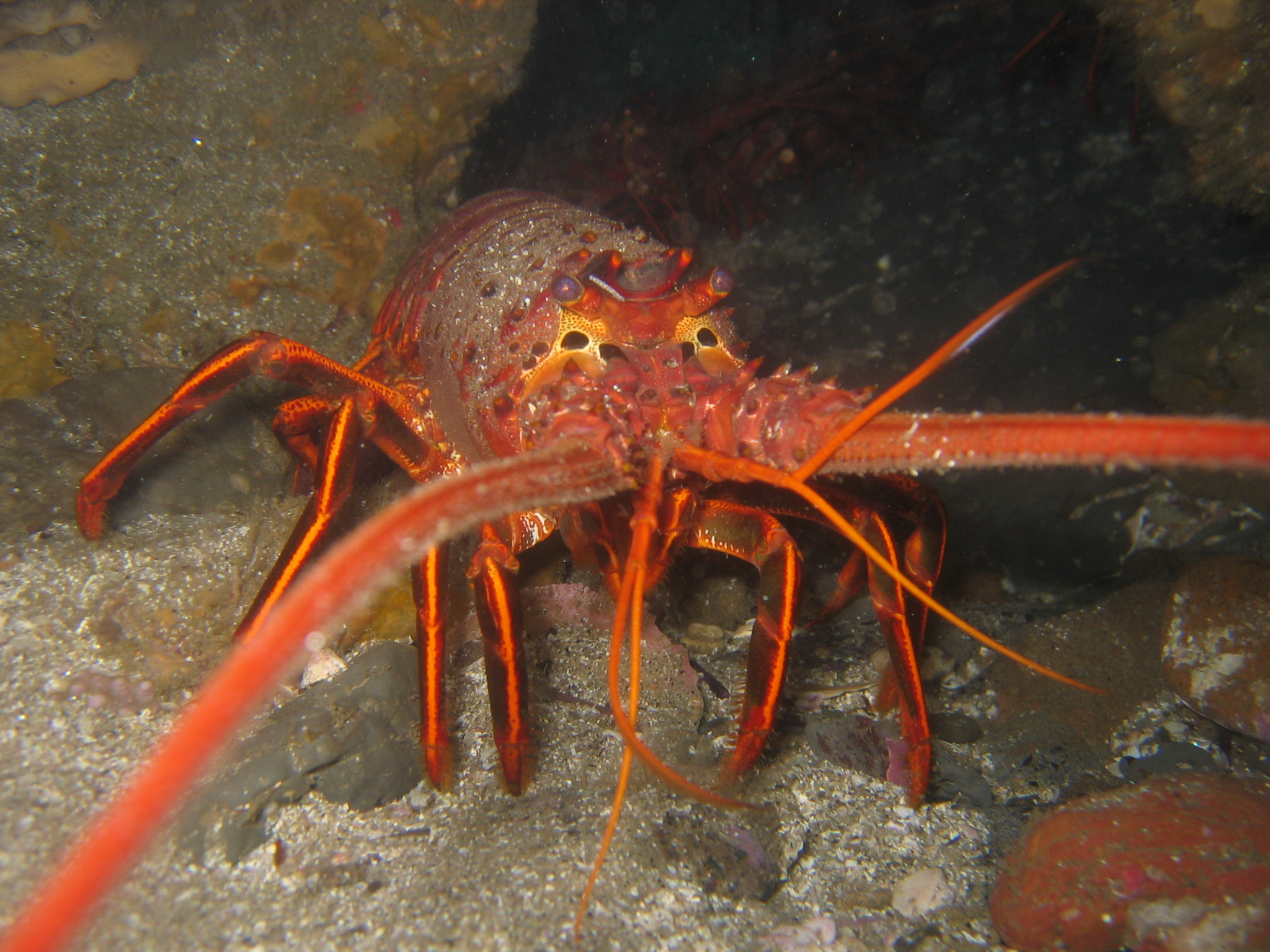
Rock Lobster is a well known and incredibly catchy song by new wave American band the B-52’s. But it is also, in fact, a real animal. The term “rock lobster” may refer to either a spiny lobster or, more specifically, Jasus lalandii, a species of spiny lobster found off the coast of Southern Africa.
Spiny lobsters are also referred to as langustas, langoustes, or rock lobsters and are a marine decapod crustacean. While they may resemble true lobsters, spiny lobsters are characterized by their long, thick antennae and lack of chelae (claws) on their first four pairs of walking legs. While still missing the first four, the females of most species have a small claw on their fifth pair of walking legs. Spiny lobsters also have a slightly compressed carapace, a long and tapering flagellum (found at the top of the antenna), and ambulatory legs ending in chelae.

Spiny lobsters live in the crevices of rocks and coral reefs and feed at night on organisms such as snails, clams, crabs, or urchins. They can sometimes be found in large groups (more than 50!) that migrate across the sea floor. These groups travel in long lines and keep together by contact through their antennae. They can rub these antennae together to produce a loud screech that can be used to deter predators. Spiny lobsters can be found in almost all warm seas but are especially common in Australasia and South Africa.

Jasus lalandii is the particular species of spiny lobster found off the coast of South Africa. It is commonly referred to as the Cape rock lobster, West Coast rock lobster, or South African rock lobster. They are orange or reddish-brown in appearance with an orange, blue, and green tail fin. Like other spiny lobsters, they display long antennae, lack of chelae, and stalked black eyes. They can swim backwards in emergencies with their tail, but generally crawl around the rocky reef habitats in which they are found.
Leave a Reply